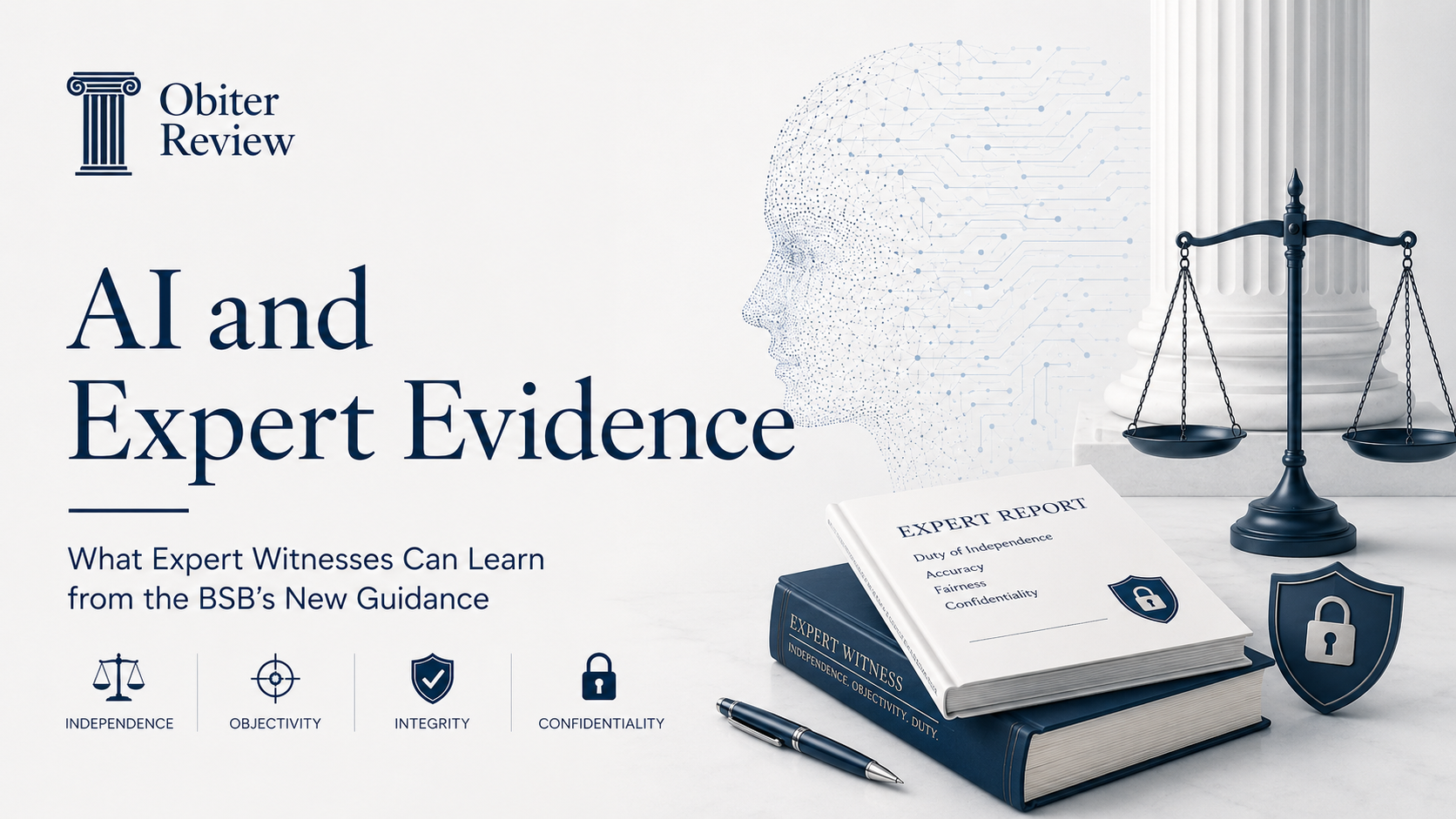
The Bar Standards Board’s new guidance on artificial intelligence and other technologies is directed at barristers, but its implications reach much further. Expert witnesses, particularly those working with sensitive, complex or high-stakes material, should read it as a clear indication of where professional expectations are heading.
The central message is simple: AI may assist professional work, but it does not dilute professional responsibility. The same principle applies to expert evidence. AI does not sign the report, give oral evidence, or face cross-examination. The expert does.
AI literacy is becoming part of professional competence
The guidance places strong emphasis on competence. Barristers are expected to understand the benefits, risks and limitations of AI tools sufficiently to use them safely. Expert witnesses should adopt the same approach.
This does not mean every expert must become a technologist. It does mean that an expert who uses AI should understand, in practical terms, what the system is doing, what it is not doing, and where error may arise.
A generative AI tool may produce a fluent chronology or apparently coherent summary of records. But it does not understand clinical significance, evidential weight, causation, diagnosis, prognosis, capacity, risk, or legal relevance in the way an expert does. It may omit important details, overstate weak points, or produce a misleading synthesis.
For expert witnesses, AI literacy is therefore not optional if AI is being used. It is part of using the tool responsibly.
Responsibility cannot be outsourced
One of the most important lessons from the guidance is that professional responsibility remains with the professional. For expert witnesses, that principle is fundamental.
An expert cannot justify an inaccurate report by saying that an AI system produced the summary, assisted with the drafting, or suggested the wording. The report must reflect the expert’s own independent opinion, based on their own assessment of the evidence.
This is especially important because AI outputs can appear polished and authoritative even when they are wrong. A misstated date, an omitted consultation, an invented reference, or a distorted chronology may materially affect the reliability of an expert opinion.
The proper role of AI is assistive. It may help organise material, support administration, generate checklists, or assist with early review. It must not replace independent professional judgement.
Verification is essential
The guidance rightly highlights the risk of inaccurate AI outputs, including false legal citations. Expert witnesses face equivalent risks in their own fields. AI may misstate research, misquote guidance, invent sources, or summarise technical material inaccurately.
Any AI-assisted output that influences an expert report should be checked against the primary material. That means medical records, interview transcripts, witness statements, test results, correspondence, published literature, and the actual instructions.
A practical rule is this: if the expert could not defend the point under cross-examination without relying on the AI output, it should not appear in the report as the expert’s opinion.
Verification cannot simply mean asking the same AI system whether it is correct. It means returning to the source material and applying professional expertise.
Confidentiality and data security are critical
The BSB guidance gives significant attention to confidentiality, data protection, privilege, and the risks of entering sensitive material into inappropriate AI systems. These issues are particularly important for expert witnesses.
Expert reports often involve highly confidential material: medical histories, psychiatric records, criminal allegations, family proceedings, employment records, immigration histories, substance misuse, financial information, and details about third parties.
Before using any AI tool, an expert should ask:
What information is being uploaded?
Where is it processed?
Is it retained?
Can it be used for model training?
Is it transferred outside the UK?
Can it be deleted?
Is there a suitable contractual and data protection framework?
Has the use been agreed where necessary?
Free or general-purpose AI systems will often be unsuitable for confidential case-specific material unless the safeguards are clear, robust and appropriate.
Why Obiter Review fits this direction of travel
This is where a platform such as Obiter Review fits well with the emerging professional landscape.
The BSB guidance does not say that professionals should avoid technology. On the contrary, it recognises that technology can improve quality, efficiency and client service. The issue is not whether AI should be used, but whether it is used safely, proportionately and under proper control.
Obiter Review is designed around precisely those concerns. Its emphasis on local or on-premises processing is important because it reduces the need to transmit confidential case material to external, general-purpose AI systems. That matters in expert witness work, where source documents commonly contain sensitive personal data, privileged material, and information that should not be exposed to uncontrolled third-party processing.
A security-focused, locally controlled workflow also supports better governance. It allows the expert or organisation to define what material is processed, how it is handled, who has access to it, and how outputs are checked before being incorporated into professional work. That is far closer to the risk-based approach now being encouraged across legal practice.
Obiter Review also aligns with the principle that AI should assist, not replace, professional judgement. The value lies in helping experts manage large volumes of material, identify potentially relevant issues, and compare draft reports against the underlying evidence. The expert remains responsible for the interpretation, reasoning and final opinion.
In that respect, Obiter Review is not simply an efficiency tool. It is a response to the central professional challenge identified by the guidance: how to gain the benefits of AI while preserving confidentiality, accountability, verification and professional independence.
Experts need clear AI governance
Expert witnesses should now consider having their own AI policy or standard operating procedure. This does not need to be elaborate, but it should be clear.
It should distinguish between administrative use, document review, summarisation, drafting support, and opinion formation. It should specify which tools are approved, what information may be entered, what is prohibited, how outputs are verified, and how material use of AI is recorded.
Such governance is not bureaucracy for its own sake. It is evidence that the expert has taken a deliberate, informed and proportionate approach.
Transparency must be handled carefully
Not every minor use of AI will require disclosure. There is a clear difference between using AI to improve the grammar of a generic email and using it to summarise thousands of pages of records or assist with a draft opinion.
However, where AI materially affects the preparation of an expert report, the expert should consider whether disclosure is necessary or prudent. Relevant factors include the nature of the case, the sensitivity of the data, the extent of AI involvement, the instructions, and any court or procedural expectations.
Even where proactive disclosure is not required, the expert should be able to answer honestly and clearly if asked whether AI was used and, if so, how.
AI use by others must also be recognised
Experts should also be alert to AI-generated material received from others. Letters of instruction, chronologies, schedules, questions, or summaries may have been produced with AI assistance. They may look organised and authoritative while containing errors or omissions.
The expert’s task is unchanged: return to the evidence, distinguish fact from assertion, and apply independent expertise.
Conclusion
The BSB guidance should be seen as part of a broader shift in professional standards. AI is becoming a normal feature of legal and expert work, but its use must be competent, secure, transparent where necessary, and subject to professional judgement.
For expert witnesses, the key lessons are clear. Understand the tools. Protect confidentiality. Verify outputs. Keep proper records. Use AI only where it is appropriate and proportionate. Above all, remember that responsibility remains with the expert.
AI may assist expert evidence. It must not replace expertise.